AI Insights
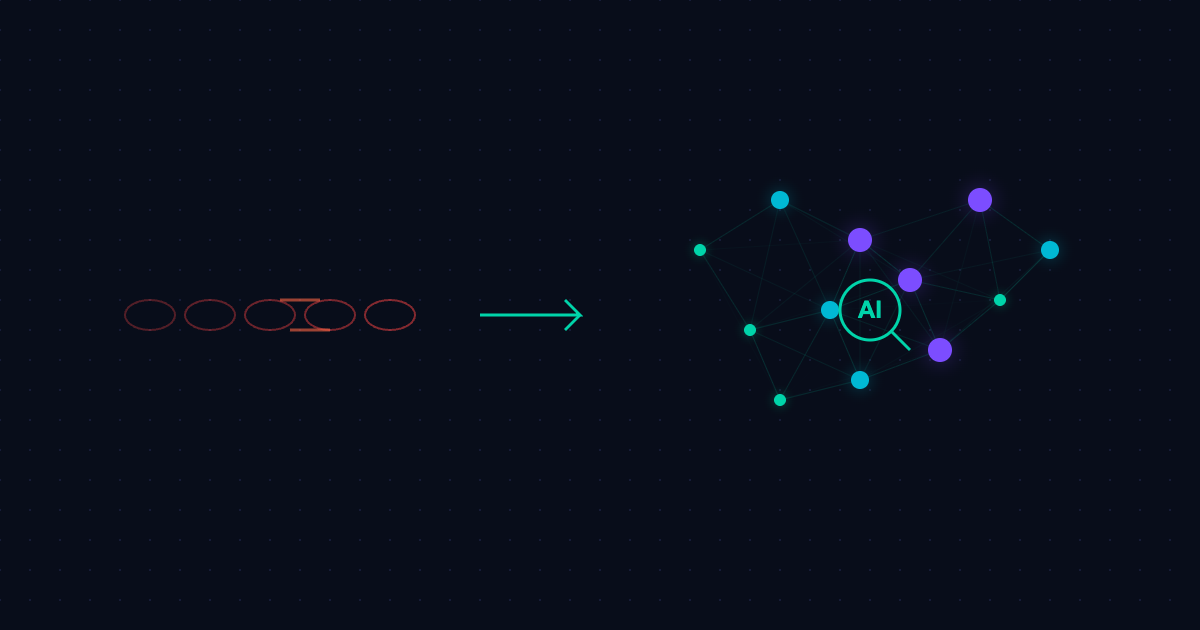
If your business website still looks and works the same way it did three years ago — static pages, keyword-stuffed blog posts, a contact form buried in the footer — you are building for a world that no longer exists. The majority of web agencies and SEO consultants are still selling the old playbook: build a standard brochure site, stuff it with keywords, chase backlinks, and wait for Google to send traffic. Meanwhile, the entire landscape has shifted underneath them.
68% of Google searches now end without a single click. AI Overviews now appear on more than 20% of queries — and when they do, click-through rates for the top result fall sharply. And visitors arriving from AI-generated answers are 4.4 times more valuable than traditional organic traffic. The businesses that understand this shift are building AI-augmented websites and optimising for AI search engines — not just Google’s blue links. The ones that don’t are spending money on a strategy with rapidly diminishing returns.
For the last decade, the formula was simple: build a clean website, write content targeting high-volume keywords, optimise your title tags and meta descriptions, build backlinks, and watch the organic traffic roll in. It worked. For a long time, it worked extremely well.
But the economics have fundamentally changed. Ahrefs’ analysis of 300,000 keywords found that the presence of an AI Overview correlated with a 34.5% lower click-through rate for the top-ranking page — and its February 2026 update put the decline at 58% as AI Overviews expanded. The traffic that traditional SEO delivers is shrinking — not because the strategy is being executed poorly, but because the search landscape itself has been restructured.
Google’s AI Overviews now answer the query directly on the results page. ChatGPT, Perplexity, and other AI search tools provide synthesised answers without sending users to a website at all. Gartner has projected that search engine volume will drop by 25% as users migrate to AI-powered alternatives. For B2B technology companies, the exposure is even higher — BrightEdge data shows B2B tech is among the sectors most transformed by AI Overviews, with the share of queries triggering AI search results expanding dramatically.
Yet most web agencies are still selling the same packages they sold in 2020. Standard WordPress site, monthly SEO retainer, keyword reports, and backlink campaigns. They are optimising for a declining channel while ignoring the one that is replacing it.
An AI-augmented website is not a standard site with a chatbot bolted on. It is a fundamentally different approach to how a business engages visitors, captures leads, and delivers value online.
The traditional website asks visitors to fill out a contact form and wait. An AI-augmented website has an intelligent assistant that can answer product questions, qualify leads, book meetings, and guide visitors to the right solution — in real time, 24 hours a day. The pattern is consistent: businesses that add AI-powered chat report capturing substantially more leads than those relying on static forms, because most visitors want an instant answer rather than a callback.
A standard business website shows the same content to every visitor regardless of who they are or what they need. An AI-augmented website adapts. It recognises whether a visitor is a first-time browser or a returning prospect. It adjusts messaging, case studies, and calls to action based on the visitor’s industry, behaviour, and stage in the buying journey. McKinsey’s research shows that this kind of personalisation can reduce customer acquisition costs by as much as 50% while lifting revenues by 5-15%.
Rather than maintaining hundreds of static blog posts and hoping the right one ranks, AI-augmented websites can dynamically generate and surface content based on what each visitor is looking for. They can synthesise answers from your knowledge base, recommend relevant resources, and create personalised experiences that keep visitors engaged rather than bouncing to a competitor.
The conversion impact is substantial. Businesses adopting AI-driven personalisation and engagement consistently report double-digit conversion improvements over static, one-size-fits-all sites.
Honest cost benchmarks, the hidden costs vendors don’t quote, and a 10-line scoping worksheet — everything you need before requesting quotes.
Get the free guideGet the free Australian AI MVP Cost Guide 2026 — we’ll email it straight to you.
Traditional SEO optimises for ranking position — the goal is to appear as high as possible in Google’s organic results. AI search optimisation, often called Answer Engine Optimisation (AEO), has a fundamentally different objective: being cited as the authoritative source when an AI engine generates a response.
This distinction matters more than most businesses realise.
Nearly a third of the US population now uses generative AI search tools. These platforms — ChatGPT, Google’s AI Overviews, Perplexity, Claude — do not display ten blue links. They synthesise information from multiple sources and present a single, conversational answer. Being ranked number one on Google is irrelevant if the AI overview answers the question before anyone scrolls to the organic results.
AEO focuses on making your content the source that AI engines pull from. This requires structured data, schema markup, clear question-and-answer formatting, and content that AI language models can easily parse and cite. Citations in AI responses are becoming the new backlinks — they build authority, trust, and visibility in ways that traditional rankings increasingly cannot.
Here is the statistic that should make every business leader pay attention: Semrush found the average visitor arriving from AI search is 4.4 times as valuable as the average visit from traditional organic search, based on conversion rate. The volume may be lower, but the intent and quality are dramatically higher. These are people who have already received a detailed answer from an AI engine and are clicking through because they want to engage further — they are pre-qualified in a way that traditional organic traffic simply is not.
Optimising for AI search engines requires a different content strategy than traditional SEO. Instead of targeting keywords and hoping for rankings, AEO involves providing direct, authoritative answers to specific questions within the first 100 words of your content. It means using structured data and schema markup so AI engines can understand your content’s context and authority. FAQ sections, clear H2/H3 question-based headings, and concise answers are essential. Building topical authority — becoming the recognised expert source in your domain — matters more than backlink volume. And content needs to be written for both humans and AI parsers, which requires a clarity and structure that most keyword-optimised content lacks.
Businesses that continue investing exclusively in standard websites and traditional SEO are not just missing an opportunity — they are actively falling behind. The gap is widening every quarter.
Consider what the old approach actually delivers in 2026: a static website that shows the same content to every visitor, a blog that targets keywords with rapidly declining click-through rates, a contact form that most visitors never fill out, and organic traffic that is shrinking as AI Overviews expand to more queries. Compare that to what an AI-augmented approach delivers: a website that adapts to each visitor and captures substantially more leads, content that gets cited by AI search engines and sends traffic that is 4.4 times more valuable, intelligent automation that qualifies leads and books meetings around the clock, and a competitive moat that grows as your AI systems learn from every interaction.
The businesses that are still being sold standard websites and SEO packages are paying for yesterday’s strategy at today’s prices. And the agencies selling those packages have little incentive to change — AI-augmented websites require a fundamentally different skill set than spinning up a WordPress theme and writing monthly blog posts.
The shift from traditional to AI-augmented web presence is not something that happens overnight. But the direction is clear, and the earlier you start, the greater the advantage.
Audit your current website through an AI lens. Ask: does it adapt to different visitors? Can it engage prospects intelligently? Is the content structured for AI engines to parse and cite? If the answer to all three is no, you are leaving money on the table.
Add AI-powered engagement as a priority. An intelligent assistant on your website is the single highest-ROI change most businesses can make right now. It captures more leads, qualifies them automatically, and provides instant responses — something a static contact form will never do.
Start optimising for AI search alongside traditional SEO. Restructure your content to answer specific questions directly. Add schema markup. Build topical authority through comprehensive, well-structured content. You do not need to abandon SEO — but you need to expand beyond it.
Work with partners who understand AI, not just web design. The skills required to build an AI-augmented website are fundamentally different from those needed for a standard WordPress site. You need teams that understand machine learning, natural language processing, data architecture, and AI product development — not just HTML and keyword research. Neomeric specialises in exactly this intersection — building AI-powered products and digital experiences that deliver measurable business outcomes.
The businesses that will dominate their markets over the next five years are not the ones with the best-looking static websites or the most backlinks. They are the ones that use AI to create intelligent, adaptive web experiences and ensure their expertise is visible to the AI engines that increasingly mediate how buyers find information and make decisions.
If your web agency is still talking exclusively about keywords, rankings, and backlinks — and not about AI augmentation, answer engine optimisation, and intelligent automation — it is time to ask whether they are building for the future or maintaining the past.
Talk to Neomeric about building an AI-augmented web presence that actually converts. We help businesses move beyond static websites and traditional SEO into the AI-powered future — where the real growth is happening.
Neomeric is an AI product development and consulting company helping businesses build, launch, and scale AI-powered products and digital experiences. Get in touch to discuss your next project.
Neomeric is a Melbourne AI product studio — 7+ products shipped, including our own. Start with a free 15-minute scoping call, or a 2-week Build Sprint at A$6,900 fixed, fully credited toward your pilot.
Book a free scoping callDownload the cost guideWhat an AI MVP really costs in Australia in 2026 — line-item budgets, the traps that blow them out, and how to scope a build that pays for itself.
 AI Insights
AI product pricing models compared: per-seat, usage-based and outcome-based, with a hybrid design method and an Australian lens. Read the guide first.
 AI Insights
AI for dental practices in Australia: what AI teammates handle, what stays clinical, Ahpra and privacy rules, onshore hosting, setup time. Read the guide.
 AI Insights
How to build an AI product cost model: trace one request, price tokens with caching, model real usage, add non-token costs, stress-test margin. Start now.