Product Development
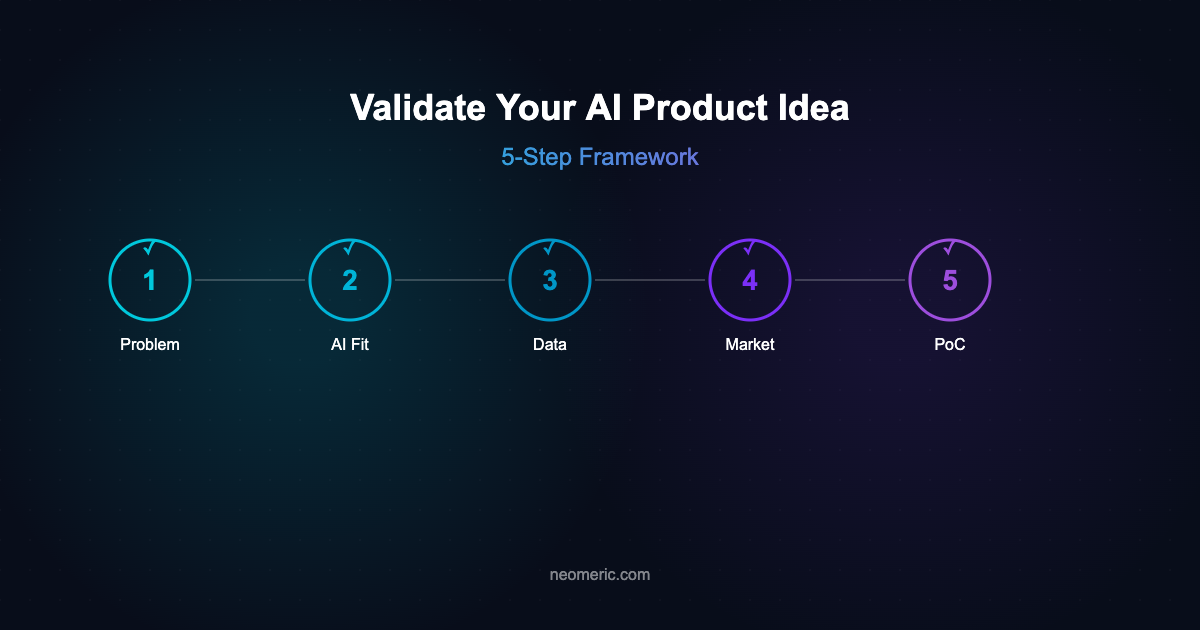
Not every AI product idea deserves to be built. Before you invest months of development time and tens of thousands of dollars, you need a structured way to separate promising concepts from expensive distractions. Here’s a practical, five-step framework for validating an AI product idea — so you can move forward with confidence or kill it early.
Traditional software validation focuses on user demand and technical feasibility. AI products add extra layers of complexity: you need the right data, the right model architecture, and a clear reason why AI outperforms simpler alternatives.
The stakes are well documented: RAND research found more than 80% of AI projects fail — twice the failure rate of non-AI IT projects — and Gartner predicted that 30% of generative AI projects would be abandoned after proof of concept. Skipping validation is one of the most expensive AI mistakes businesses make. The good news? A structured checklist can save you from building something nobody needs — or something that’s technically impossible.
Before you think about models or data, answer one question: does this problem actually cause measurable pain for a specific group of people?
What to do:
Red flag: If your interviews keep producing polite interest but no urgency, the problem isn’t validated.
Honest cost benchmarks, the hidden costs vendors don’t quote, and a 10-line scoping worksheet — everything you need before requesting quotes.
Get the free guideGet the free Australian AI MVP Cost Guide 2026 — we’ll email it straight to you.
AI is powerful, but it’s not always the best tool. A rules-based system, a simple automation, or even a better spreadsheet might solve the problem faster and cheaper.
Ask yourself:
If AI doesn’t offer a measurable improvement over the status quo, you don’t have an AI product — you have a regular software product wearing an AI label.
AI products live and die by data. The most elegant model architecture means nothing if you can’t access, clean, and maintain the data it needs.
Run through this checklist:
Many AI product ideas fail not because the concept is bad, but because the data pipeline is prohibitively expensive or simply doesn’t exist. Understanding this early is critical to measuring AI ROI accurately.
A validated problem with a viable AI solution still needs a market. You need to know who will pay, how much, and whether there are enough of them.
How to test this quickly:
A 2026 best practice: combine AI-powered market research tools with traditional customer interviews. Tools can compress TAM analysis to hours, but nothing replaces hearing a prospect say “I’d pay for that” on a call.
Notice this is step five, not step one. Too many teams jump straight to building before validating the problem, the approach, the data, and the market.
Your proof of concept should:
Run the PoC with 10 to 20 target users. Collect both quantitative data (task completion rates, accuracy) and qualitative feedback (what confused them, what they wished it did differently).
After completing these five steps, you’ll have the evidence to make a clear decision:
The hardest part of validation isn’t running through the steps — it’s being honest about the results.
At Neomeric, we help founders and enterprise teams validate, build, and launch AI products through our AI Product Incubation service. Whether you’re exploring an idea or ready to build a proof of concept, we’ll help you make the right call — before you invest.
Neomeric is a Melbourne AI product studio — 7+ products shipped, including our own. Start with a free 15-minute scoping call, or a 2-week Build Sprint at A$6,900 fixed, fully credited toward your pilot.
Book a free scoping callDownload the cost guideWhat an AI MVP really costs in Australia in 2026 — line-item budgets, the traps that blow them out, and how to scope a build that pays for itself.
 Product Development
A 30-day, four-week checklist for founders to validate an AI product idea before building — covering problem, data, willingness to pay, and unit economics.
 Product Development
Use this 15-point AI product scaling checklist to fix infrastructure, data, and operational gaps before you grow. Covers everything from data pipelines to team readiness.
 Product Development
Most businesses struggle to quantify the value of their AI investments. Here's the measurement framework we use at Neomeric to set expectations, track outcomes, and prove business impact.