Product Development

AI investment is surging — Gartner forecasts worldwide AI spending to total $2.5 trillion in 2026 — but the ability to measure its return hasn’t kept pace. MIT research found 95% of enterprise generative AI pilots deliver no measurable P&L impact. Most organisations we work with can tell you what they spent on AI. Very few can tell you what they got back. That gap isn’t just a reporting problem. It’s a strategic one: if you can’t measure it, you can’t improve it, justify it, or scale it.
Here’s the framework we use with every client to make AI ROI measurable from day one.
This sounds obvious, but it’s the step most teams skip. Before deploying any AI solution, you need to document the current state of the process you’re automating or augmenting. That means capturing:
Without this baseline, you’ll have nothing to compare against — and any claims about ROI will be guesswork.
AI ROI usually comes in two forms, and it’s important to account for both separately:
Soft benefits matter and should be included in your business case — but separately. Conflating them with hard savings is how ROI claims lose credibility with finance teams.
Honest cost benchmarks, the hidden costs vendors don’t quote, and a 10-line scoping worksheet — everything you need before requesting quotes.
Get the free guideGet the free Australian AI MVP Cost Guide 2026 — we’ll email it straight to you.
AI projects have more costs than most teams account for upfront. A complete cost picture includes:
We’ve seen projects that looked highly profitable on paper become marginal when inference costs were properly accounted for at scale. Model pricing can change dramatically month to month — build that variability into your projections.
Most AI projects have a negative ROI in months one and two — you’re paying for build without yet capturing value. The question is whether the payback period is acceptable given your cost of capital and strategic priorities.
As a rough guide from our experience: tactical automation projects (e.g., automating a specific workflow) typically hit payback in 3–6 months. More transformative projects (e.g., building a new AI-native product) should be evaluated over 18–36 months.
Once your AI system is live, ROI tracking should be automated wherever possible. The metrics dashboard we recommend includes:
Review this monthly with stakeholders. It keeps the project accountable and surfaces issues — like rising inference costs or declining accuracy — before they become serious.
Measuring AI ROI isn’t just about justifying past investment — it’s about informing future investment decisions. The businesses we see getting the most out of AI aren’t the ones with the biggest budgets. They’re the ones that treat each deployment as a learning exercise, measure relentlessly, and double down on what works.
Further reading: Build vs. Buy AI: A Decision Guide for Business Leaders | The 5 Most Expensive AI Mistakes Businesses Make | AI Product Scaling Checklist | How to Build an AI MVP in 30 Days
If you’re building your first AI business case or reviewing an existing AI investment, the Neomeric team is happy to help. We’ve built the measurement frameworks — we can help you apply them to your situation.
Neomeric is a Melbourne AI product studio — 7+ products shipped, including our own. Start with a free 15-minute scoping call, or a 2-week Build Sprint at A$6,900 fixed, fully credited toward your pilot.
Book a free scoping callDownload the cost guideWhat an AI MVP really costs in Australia in 2026 — line-item budgets, the traps that blow them out, and how to scope a build that pays for itself.
 Product Development
A 30-day, four-week checklist for founders to validate an AI product idea before building — covering problem, data, willingness to pay, and unit economics.
 Product Development
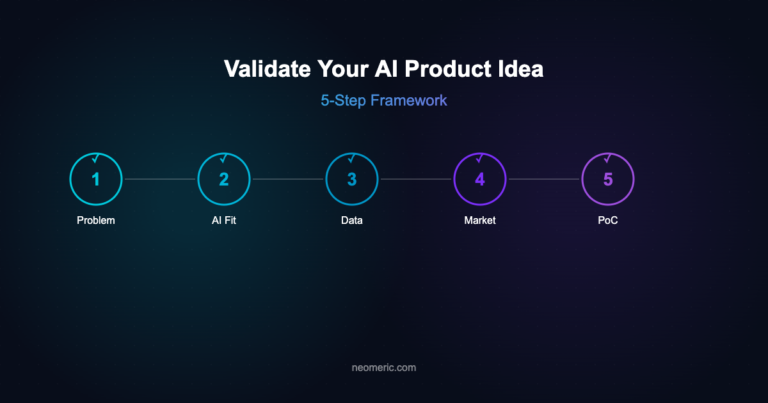
Learn how to validate an AI product idea before investing. This 5-step checklist covers problem validation, data feasibility, market sizing, and more.
 Product Development
Use this 15-point AI product scaling checklist to fix infrastructure, data, and operational gaps before you grow. Covers everything from data pipelines to team readiness.